
In short
An advertising film production company in Delhi such as Sunad Broadcast produces TVCs and digital brand films end to end — concept and storyboard, casting and location, shoot, edit, grade, sound and music — and delivers the campaign in every duration, aspect ratio and format the client's television and digital buys require.
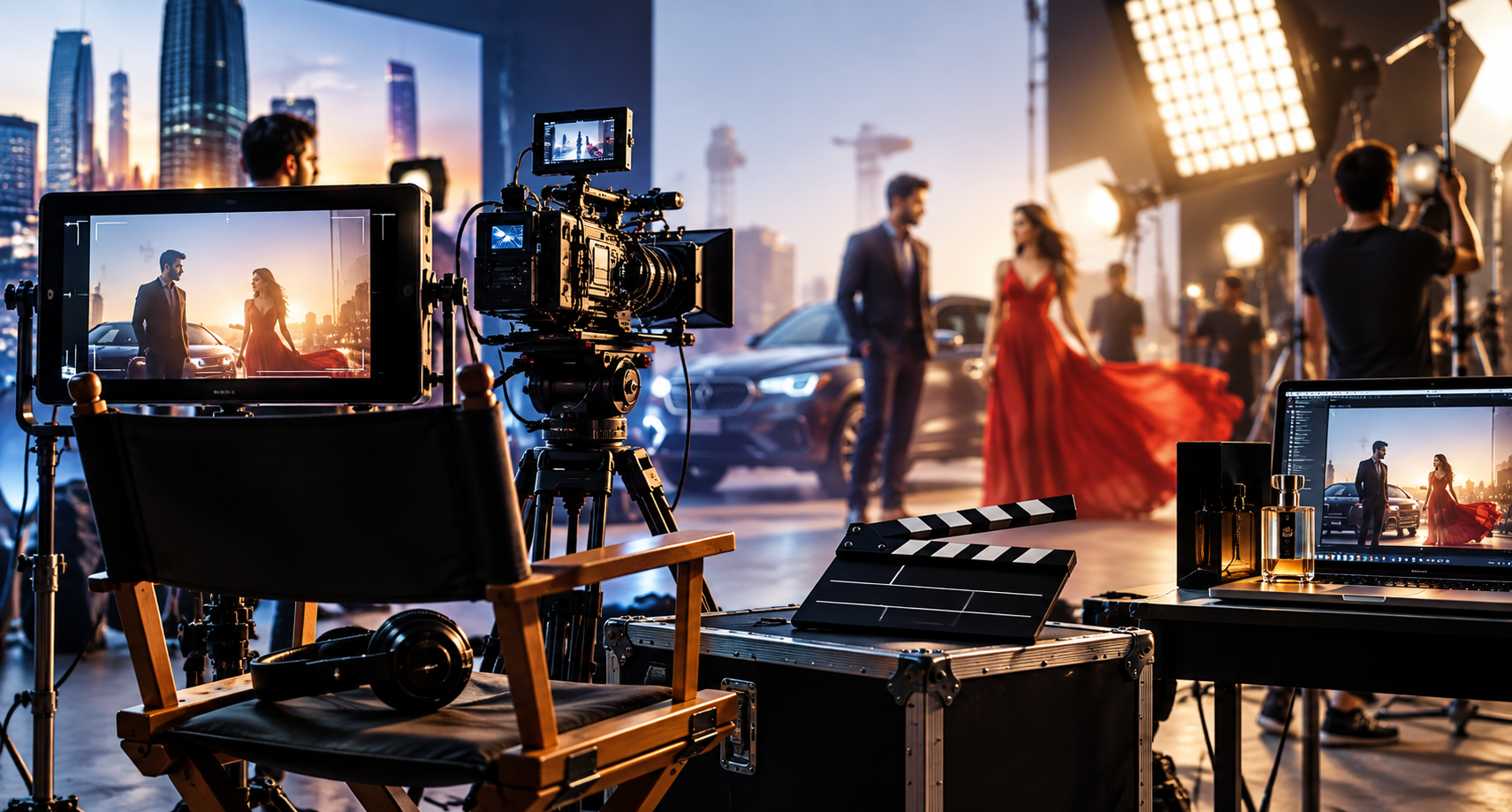
An advertising film has one job: to make a specific audience feel something specific about a brand, in thirty seconds or fewer, often with the sound turned off. Everything else — the camera package, the location, the cast, the grade — exists only in service of that. Sunad Broadcast produces advertising films for television and digital campaigns across India, and we start every project by agreeing what the film has to achieve before we discuss how it will look.
We work with brand teams directly and with creative agencies as their production partner. In both cases the deliverable is the same: a campaign that arrives on time, in every format the media plan requires, at broadcast-legal quality.
What makes an advertising film work
The commercials that perform share a small number of structural traits, and they have very little to do with budget.
They establish the brand early. Attribution research consistently shows that a large share of ad recall is attached to the wrong brand. Films that introduce a distinctive brand asset — a colour, a sound, a character, a logo lockup — in the first few seconds retain far more of the recall they generate.
They work without sound. The majority of digital video impressions are served muted. If the proposition only lands through a voiceover, most of the audience never receives it. We storyboard the silent version first and treat audio as reinforcement rather than as the carrier.
They say one thing. A thirty-second film can carry one idea properly or four ideas badly. The single most common failure in Indian advertising production is a brief that has been negotiated upward until the film has to communicate every feature the product has.
They are cut for the placement. A film conceived for a television slot and then mechanically cropped for Reels performs poorly. We plan the vertical and square versions at the storyboard stage, framing with the safe zones of each placement already in mind, so that every version is composed rather than salvaged.
Our production process
Brief and concept
We begin with the commercial problem, not the creative idea: what is the product, who buys it, what do they believe now, what should they believe after, and how will success be measured. From that we develop two or three distinct concepts, each with a written treatment and a visual reference film, so the choice in front of the client is between genuinely different approaches rather than between three versions of the same one.
Pre-production
The approved concept becomes a shot-by-shot storyboard, a shooting script and a production plan. This stage covers casting — usually two rounds, a wide look and a callback with the shortlist — location recce or set design, wardrobe and styling, product and prop sourcing, and the technical plan covering camera package, lenses, lighting and any specialist equipment.
We run a formal pre-production meeting before every shoot at which the client, the agency and our department heads walk through the board frame by frame. Every ambiguity resolved in that room is money not spent on the floor.
The shoot
Advertising shoots are short and dense. A one-day commercial shoot might cover twenty to thirty setups, which means the schedule has to be realistic and the unit has to be properly staffed. We shoot on cinema cameras in a log profile, light for the grade rather than for the monitor, and record product beauty passes separately so that the hero shots can be finished without compromise.
Food, beverage, cosmetics and jewellery all have specific technical requirements — a food stylist and dedicated macro optics for the first, polarisation and controlled reflection for the last — and we crew accordingly rather than treating them as ordinary product work.
Post-production
Offline editing produces the primary cut for approval. Once the cut is locked, the film goes through conform, clean-up and retouching, CGI or product visualisation where required, colour grading, sound design and mix, and music.
Music is where budgets most often surprise clients. A licensed popular track for a national television campaign can cost more than the entire production; original composition, by contrast, is usually a modest line item and gives the brand an asset it owns outright and can build equity in over successive campaigns. We recommend original score in most cases and are transparent about what licensing a known track will actually cost before anyone falls in love with it.
Delivery
A campaign package is delivered as a matrix of durations against formats. A typical set for an Indian campaign is 30, 20, 15, 10 and 6-second cuts in 16:9 at broadcast specification, the same durations in 1:1, 4:5 and 9:16 for digital, subtitled and unsubtitled versions of each, and language variants where the campaign runs across regional markets.
We prepare all of it from a single conform, so colour and audio are identical across every version, and we name and organise files to match what broadcasters and platforms actually require at ingest.
Formats and categories we produce
Television commercials for national and regional broadcast, delivered to channel specification with correct loudness and safe areas.
Digital brand films of 60 to 180 seconds, designed for YouTube, connected TV and brand-owned channels where a longer narrative can breathe.
Social-first content shot natively vertical for Reels, Shorts and Stories, produced in volume rather than as one-offs.
Product and e-commerce films including demonstration, unboxing and 360-degree product visualisation.
Corporate and B2B films for brands whose audience is a procurement committee rather than a consumer.
Public-service and government campaigns, produced to the approval and documentation standards that public procurement in India requires.
What a commercial actually costs, and why
Advertising production budgets are opaque to most clients, which is unhelpful for everyone. Here is the honest structure of where the money goes on a typical Indian TVC.
Pre-production, roughly 10–15%. Casting, recce, permissions, art department design, styling, and the production management time that holds it all together.
Crew and equipment, roughly 25–35%. Director, DOP, camera package, lighting and grip, sound, assistants and unit. This scales directly with shoot days, which is why schedule discipline is the most effective cost control available.
Cast and talent, 5–40%. The widest band in the budget. Non-professional or model casting is a modest line item; an established actor or a cricketer is frequently larger than the entire rest of the production. Usage term and territory matter as much as the headline fee — a two-year all-India licence costs multiples of a six-month regional one.
Locations and sets, 10–25%. Built sets give control and cost money; real locations cost less in rental and more in time, permissions and unpredictability.
Post-production, 15–25%. Edit, grade, clean-up, CGI, sound design and mix. Product-heavy commercials push this upward because beauty retouching and CGI product work are slow.
Music, 3–30%. Original composition is typically a small line. Licensing a recognisable film or popular track for national television can exceed the entire production cost, and the licence is time-limited, so the brand owns nothing at the end.
Where a budget is fixed and the ambition exceeds it, we say so at the treatment stage and propose what to change — usually fewer locations, a simpler cast, or a concept that achieves the same emotional beat with less machinery. A commercial that is under-resourced relative to its own idea looks worse than a simpler idea executed properly.
Working with agencies and with brands directly
Roughly half our advertising work comes through creative agencies and half directly from brand teams, and the two relationships run differently.
With an agency, the creative idea and the client relationship sit with them. Our job is to interpret the board faithfully, advise where something will not work technically or practically, and deliver. We do not pitch alternative concepts to the client behind the agency, and we do not take credit for their idea.
With a brand directly, we take on more: the strategic framing, the concept development, and often the decision about what content the campaign actually needs. Direct engagements typically save the agency margin, but they require the brand team to be genuinely available for decisions, because production moves quickly and an unanswered approval costs a shoot day.
Approvals and review rounds
We build a fixed number of review rounds into every quotation — normally two on the offline cut and one on the graded and mixed film — because unlimited revision is how advertising projects lose money and miss air dates. Additional rounds are quoted transparently rather than absorbed silently and recovered elsewhere.
We also ask, early, who the final approver is. The most common cause of delay on Indian advertising projects is a film approved by a marketing team and then reviewed for the first time by someone more senior after the shoot has wrapped.
Why produce with Sunad Broadcast
We are a broadcast company that makes advertising films, rather than a digital studio that occasionally delivers to television. That matters at the end of the process. Files leave us correctly encoded, correctly loudness-normalised and correctly captioned, because the same team maintains playout infrastructure for broadcasters and knows precisely what ingest will reject.
It matters at the start too. Because we also produce long-form television, we can plan a campaign and its supporting content as one production — the TVC, the founder film, the case-study documentary and the social cutdowns shot in the same window with the same unit, which is substantially cheaper than commissioning each separately.
Send us the brief, the intended media plan and the on-air date. We will come back with a treatment, a schedule and a costed plan that tells you what each creative decision is actually worth.
What's included
-
Concept and storyboard Script, visual treatment, mood film and shot-by-shot board.
-
Casting and talent management Models, actors, voice artists and celebrity coordination.
-
Production design and locations Sets, styling, props and permitted location units.
-
High-end post and finishing Grade, clean-up, CGI, product visualisation and compositing.
-
Music, sound design and voice Original score, licensed tracks, VO in multiple languages.
-
Multi-format campaign delivery TV cutdowns plus 16:9, 1:1, 4:5 and 9:16 digital versions.
Let us scope your project
One conversation is usually enough to map deliverables, crew and a realistic delivery date.
Frequently asked questions
How much does a TV commercial cost in India?
A single-location 30-second TVC with a small cast and a one-day shoot generally lands between ₹6 lakh and ₹15 lakh all-in. A multi-location campaign with a larger unit, a name face and significant post typically runs ₹25 lakh to ₹80 lakh. Celebrity endorsement fees, aerial units and heavy CGI sit outside those bands and are quoted separately.
How long does it take to produce a commercial?
Four to six weeks is a realistic end-to-end timeline for a standard TVC: one to two weeks for concept and pre-production approvals, one to three shoot days, and two to three weeks for post including client review rounds. Campaigns that need a celebrity, a custom set or a location outside India need longer.
Do you handle media buying as well?
No — we are a production house, not a media agency, and we think clients are better served when those functions are separate. We do deliver every file your media agency will ask for, in the exact duration and format each channel and platform specifies, which removes most of the friction at the buying stage.
What formats do I get for a digital campaign?
From a single shoot we typically deliver 16:9 for YouTube and connected TV, 1:1 for feed placements, 4:5 for Instagram and Facebook feed, and 9:16 for Reels, Shorts and Stories, each in the required durations — usually 6, 15 and 30 seconds — with and without burnt-in subtitles.
Who owns the footage that was not used?
Under our standard terms the client owns the delivered films and all original footage, and we hand over the rushes on request. Talent and music usage rights are separate and are licensed for a defined territory and term, which we set out clearly in the quotation.
Let's scope your advertising film production project
One call is usually enough to map the deliverables, the crew and a realistic delivery date.