
In short
A TV film production company in Delhi like Sunad Broadcast takes a television film or programme from script to delivered master: development and scripting, casting and crewing, studio or location shooting, post-production, and a broadcast-compliant file that passes channel QC on the first submission.
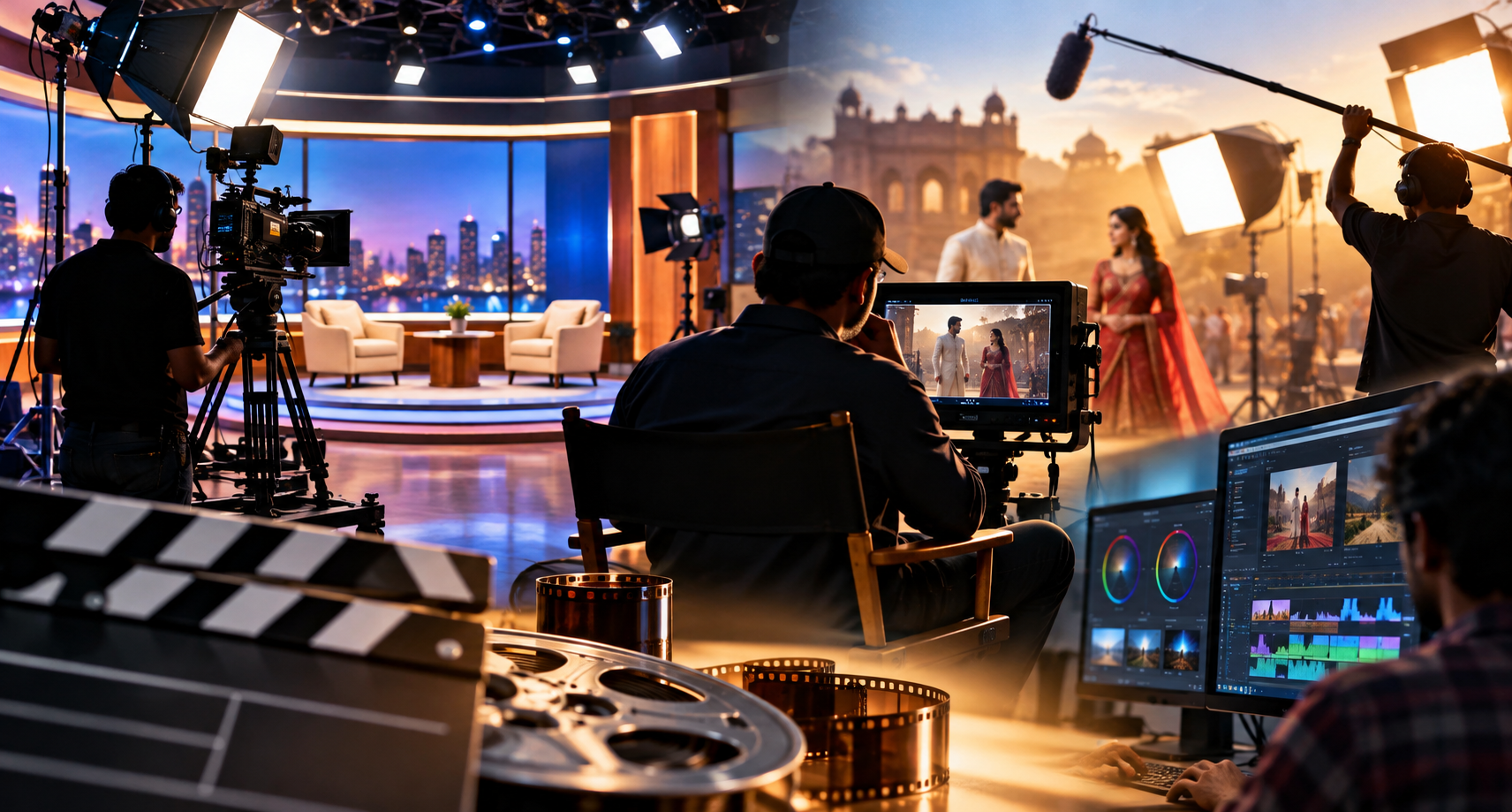
Television is an unforgiving medium to produce for. A film that looks beautiful on a laptop can be rejected by a channel's quality-control department for an audio level that drifts two decibels, a title that sits outside the safe area, or a frame rate that does not match the playout chain. At Sunad Broadcast we produce television films and programmes the way broadcasters need them made — creatively ambitious, technically exact, and delivered in a package that passes QC the first time.
We work with national broadcasters, regional channels, government departments, production houses and brands who need long-form video that will actually go to air. The scope runs from a single documentary-style television film to a full season of a studio programme, and includes everything in between: magazine shows, panel discussions, awards coverage, branded series and educational programming.
What a television production actually involves
Most clients approaching a production house for the first time underestimate how much of the work happens before a camera is switched on, and how much happens after the last shot is in the can. A useful rule of thumb for Indian television production is that shooting accounts for roughly a quarter of the total elapsed time and rather less than half of the budget. The rest sits in development, pre-production, post and delivery.
Development and scripting
Every commission begins with a treatment: what the programme is, who it is for, why anyone would watch to the end, and what the viewer should be left with. For a drama or a scripted film this becomes a screenplay through the normal stages of outline, step outline, first draft and shooting script. For factual and studio formats it becomes a format bible — running order, segment structure, presenter brief, graphics logic and recurring set pieces.
This is the cheapest stage at which to change your mind, and the most expensive one to skip. We hold a formal script lock before pre-production begins, because in television the cost of a rewrite rises roughly by an order of magnitude at every subsequent stage.
Pre-production
Once the script is locked we build the production around it. That means a shooting schedule broken down scene by scene, a budget with contingency held separately rather than hidden in line items, casting, crewing, location recce and permissions, art department and costume design, and a technical recce that confirms power, access, sound conditions and shot geometry at every location.
In Delhi NCR, location permissions deserve particular attention. Shooting at a monument requires clearance from the Archaeological Survey of India; roads and public spaces need police permission and often municipal clearance; Metro stations, airports and government buildings each have their own protocol and their own lead time. We factor these into the schedule from the first day rather than discovering them the week before the shoot.
Production
We shoot single-camera for drama and cinematic factual work, and multi-camera in a gallery configuration for studio programming, panel formats and anything with a live audience. Our standard acquisition format is 4K UHD in a 10-bit log profile, which gives the grade real latitude and futureproofs the master even when the current delivery requirement is HD.
Sound is recorded to a dedicated multitrack recorder with radio mics on speakers, a boom for perspective and room tone captured at every setup. Recording separate tracks rather than a single mixed feed is the single most useful thing a production can do for its own post-production; it is also the thing most often skipped by cheaper crews.
Post-production
Post begins with an assembly against the script, moves through a rough cut to a fine cut, and then locks. Only after picture lock do the finishing departments start work, because sound design, VFX and colour are all expensive to redo when a cut changes.
Our finishing chain covers online conform, visual effects and clean-up, motion graphics and lower thirds, sound design, ADR where required, music scoring or licensing, and a full mix balanced to broadcast loudness. Colour grading is done on a calibrated reference monitor in a controlled viewing environment, because a grade approved on an uncalibrated screen is a grade that will be rejected later.
Delivery
The delivered package is more than a video file. A complete broadcast delivery typically includes the programme master, a textless version, split audio stems, a music cue sheet, a subtitle or caption file, a programme-as-broadcast form, and a metadata package with synopsis, cast, credits and classification. We prepare all of it, run an automated QC pass against the channel's specification, and correct anything the report flags before the file leaves our facility.
Formats we produce
Television films. Single-episode fiction and docudrama, typically 45 to 90 minutes, shot single-camera with a full unit.
Serials and episodic drama. Continuing series with a fixed set, a bible and a repeating production cycle designed to deliver on a weekly or daily transmission schedule.
Studio programmes. Panel discussions, interview formats, quiz and game shows, magazine programmes and awards ceremonies, produced multi-camera with a director calling the show from a gallery.
Government and public-service programming. Scheme communication, awareness campaigns and departmental films, produced to the documentation and approval standards that public procurement requires.
Branded and corporate long-form. Founder films, capability documentaries, annual-report video and internal communication produced at broadcast standard rather than at conference-video standard.
How we price a television production
There is no useful per-minute rate in television, because a talking-head interview and a period drama occupy the same minute of screen time at wildly different costs. We price by deliverable, and the variables that move the number are consistent: total shoot days, crew size and grade, cast, locations and their permissions, art department, the amount of VFX and motion graphics, the complexity of the sound mix, and whether music is composed or licensed.
Our quotations separate the production fee from pass-through costs and list every line item, so you can see what a decision costs before you make it. If a second camera unit adds three lakh to the budget, you should be able to see that and decide whether it is worth it — not discover it in a reconciliation at the end.
Crew, equipment and the decisions that actually change a budget
Clients often ask which camera we shoot on, as though that were the variable that determines quality. In practice, three other decisions move both cost and outcome far more.
Shoot days versus setups per day. A schedule that asks for thirty setups a day will produce thirty compromised shots. Adding a single shoot day is usually cheaper than adding the second unit, overtime and reshoots that an over-packed schedule generates. We build schedules backwards from what is achievable per hour with the crew size we are proposing, and we show that working in the quotation.
Crew grade rather than crew size. A senior gaffer with two assistants will light faster and better than a junior one with five. The same is true of sound recordists, first ADs and editors. Where budgets are tight we recommend reducing headcount before reducing experience, because experienced crews recover time on the floor and that time is worth more than the saving.
Where the programme is finished. A grade and mix done properly in a calibrated room costs a fraction of the total budget and accounts for a disproportionate share of how the finished programme is perceived. It is also the first thing cut when a budget is squeezed, which is almost always the wrong choice.
Our standard technical package
For single-camera television work we shoot on large-sensor cinema cameras in 4K, recording 10-bit log internally or to an external recorder, with cine primes or high-quality zooms depending on the shooting pattern. Lighting is predominantly LED, which matters on Indian locations where power is often limited and heat is a genuine constraint on how long a crew can work.
For multi-camera studio work we build the gallery around a production switcher with sufficient M/E capability for the format, camera channels with proper CCU control so that all cameras can be matched live, a talkback system that reaches every position, and an audio desk with enough inputs to handle the panel size plus playback, VT and reserve channels.
Sound on both patterns is recorded multitrack. For studio work we record an isolated track per microphone plus the mix, which means that a guest who speaks over another can still be repaired in post rather than lost.
Quality control, compliance and the things that get programmes rejected
Indian broadcasters run automated QC on every file they ingest, and the rejection reasons are remarkably consistent. Loudness that drifts outside the permitted range. Peak levels that exceed true-peak limits once encoded. Titles or graphics that sit outside the title-safe area and get clipped on older displays. Black frames longer than the permitted duration. Photosensitive-epilepsy flash risk in graphics or archive. Duration that does not match the delivery paperwork by even a frame.
We run the same automated QC in-house before delivery and fix anything the report flags. The cost of doing so is trivial; the cost of a rejection three days before transmission is not.
Editorial compliance is a separate discipline and matters particularly for news-adjacent and public-affairs programming. India's Programme and Advertising Codes govern what may be shown, and the obligation sits with the broadcaster — which means a producer who delivers non-compliant material has created a problem for their client rather than for themselves. We flag compliance risk during the edit, not after it.
Working with Sunad Broadcast
What distinguishes our production work is that the engineering side of the company sits in the same building. When a broadcaster changes its delivery specification, we hear about it from the integration team who maintain that broadcaster's playout chain — not from a rejection notice. When a programme needs to be repurposed for an OTT platform with different aspect ratios and bitrate ladders, the people who run those encoders are colleagues rather than a third-party vendor.
That connection also shapes how we plan. A production designed alongside its playout and branding requirements ends up cheaper and faster than one that discovers those requirements at the end, because the graphics package, the audio stems and the version management are all built once instead of twice.
If you have a television film, a programme strand or a full season in front of you, the fastest way to start is to tell us the format, the intended slot, the delivery date and a budget range. We will come back with an honest assessment of what is achievable — including, occasionally, the advice that the schedule you have in mind does not work and what would need to change for it to.
What's included
-
Concept and script development Format design, treatment, screenplay and episode bibles.
-
Casting and crewing Talent, direction, camera, sound, art and production management.
-
Studio and location production Multi-camera galleries, single-camera drama and controlled location units.
-
Post-production and mastering Offline, online, VFX, sound design, mix and grade.
-
Broadcast-compliant delivery Correct codec, loudness, caption and metadata packages for Indian and international channels.
-
Rights and clearance management Music licensing, talent releases, archive clearance and chain of title.
Let us scope your project
One conversation is usually enough to map deliverables, crew and a realistic delivery date.
Frequently asked questions
How long does a television film take to produce?
A single-episode television film of 45 to 90 minutes typically runs eight to fourteen weeks from commission to delivered master: three to five weeks of development and pre-production, eight to fifteen shoot days, and four to six weeks of post. A weekly studio programme, once the format is locked, settles into a production cycle of three to five days per episode.
Do you produce in languages other than Hindi and English?
Yes. We produce and deliver in Hindi, English, Punjabi, Bengali, Marathi, Tamil, Telugu and Kannada, either by shooting in the language or by producing localised versions with dubbing, subtitling and language-specific graphics from a single master.
What delivery formats do you provide?
We deliver to the channel's own specification. Most Indian broadcasters accept XDCAM HD422 at 50 Mbps or ProRes 422 HQ in an MXF or MOV wrapper, at 1080i50 or 1080p25, with audio mixed to -23 LUFS in line with ITU-R BS.1770. We also deliver 4K UHD masters, split audio stems, textless elements, caption files and the full metadata package.
Can you work with our in-house team?
Regularly. We are often brought in to supply direction and post while the client provides the studio and floor crew, or to take over post-production on a programme shot by someone else. We scope exactly which roles sit with us and which stay with you before anything is signed.
Who owns the copyright in the finished programme?
The commissioning client does, unless the agreement says otherwise. We assign all rights in the completed work on final payment and hand over the project files, clearance documents and music cue sheets along with the master.
Let's scope your television film & programme production project
One call is usually enough to map the deliverables, the crew and a realistic delivery date.