
In short
Channel branding and playout services cover everything a viewer sees between programmes and everything that keeps a channel on air: the on-air identity and motion graphics package, promos and idents, live graphics and tickers, and the automated playout chain that schedules, brands and transmits the signal 24×7.
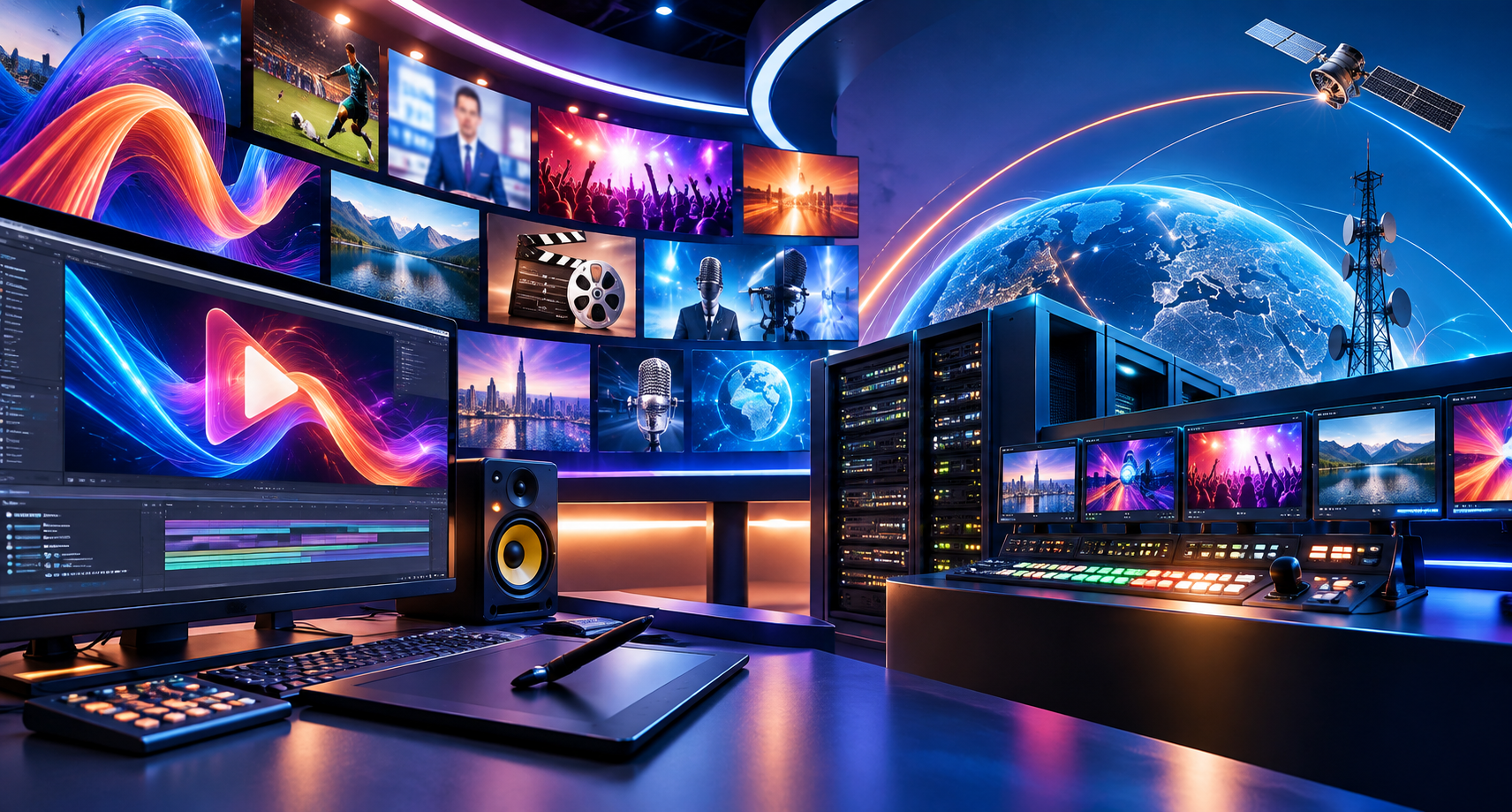
Viewers judge a channel in the gaps. They form an opinion about production values from an ident, decide whether a bulletin is credible from the way its ticker moves, and notice instantly when a break comes back late. Channel branding and playout are the parts of television that nobody praises when they work and everybody notices when they do not.
Sunad Broadcast designs on-air identities, produces the motion graphics packages that carry them, and builds and operates the playout chains that put them to air. We treat branding and playout as one discipline because they are: a beautiful graphics package that the playout automation cannot trigger cleanly is worth nothing at eleven o'clock at night.
On-air identity
A channel's identity is a system, not a logo. It has to survive being applied thousands of times a day by operators working at speed, across programmes of wildly different tone, on screens ranging from a 65-inch television to a phone held vertically.
What we design
The core of an identity package is the animated logo and the family of idents built around it — short, distinctive, and varied enough that viewers do not tire of them after a week. Around that sits the working furniture: lower thirds and name supers, headline and topic bands, transitions and bumpers, sting and stab elements, squeeze-backs for advertising, end-credit beds, and the promo end-board template.
Every element is delivered as an editable project file plus rendered variants with alpha channels, and accompanied by a written guideline document covering typography, colour values, animation timing, safe areas and usage rules. That document is what allows a channel to commission work from anyone in future and still look like itself.
Designing for Indian broadcast
Indian channels carry more on-screen information than almost any other market, particularly in news. A typical bulletin frame may carry a logo bug, a headline band, a scrolling ticker, a topic super and a live badge simultaneously. That density has to be designed deliberately rather than accumulated by addition.
Multilingual typography is the second constraint. Devanagari, Bengali, Tamil, Telugu and Latin scripts have different vertical metrics and different ideal line spacing. A lower third designed only in Latin will break the first time a long Hindi name is typed into it. We design and test every text element in each script the channel actually uses.
Promos and campaign packaging
Promos are the highest-leverage content a channel produces: they occupy inventory the channel already owns and directly drive tune-in. We produce programme promos and tune-in spots, seasonal and festival packaging, launch campaigns for new strands, and the short social versions that increasingly carry more reach than the on-air versions.
Playout
Playout is the technical chain that turns a schedule and a content library into a continuous transmission stream. Modern playout is heavily automated, but automation only removes the routine work — it does not remove the need for someone who understands what to do when a file fails to load.
Architecture
For most channels we recommend an integrated channel-in-a-box architecture, where playout, branding, audio processing and subtitle insertion run within a single software system on redundant hardware. It is dramatically less expensive than a discrete chain of specialist devices, easier to staff, and entirely capable of broadcast-grade output.
Discrete playout — separate video servers, branding processors, master control switchers and audio processors — remains appropriate for large multi-channel operations, where the ability to replace one element without touching the rest justifies the added cost and complexity.
Cloud and hybrid playout is now a serious option for channels with predominantly pre-recorded schedules, particularly for FAST channels and OTT-first services. It converts capital cost into operating cost and scales quickly. For live-heavy news it is still usually the wrong answer, because the contribution path becomes the weak link.
Automation and traffic
The playlist comes from traffic and scheduling. We integrate playout automation with the channel's traffic system so that the on-air schedule, the advertisement log and the as-run report form a single closed loop. Without that integration, reconciliation becomes a manual job and billing errors follow.
Secondary events — logo bugs appearing and disappearing, tickers starting and stopping, squeeze-backs around breaks, subtitle insertion — are all driven from the same playlist, which is what allows a single operator to run a channel cleanly.
Ingest, QC and compliance
Content entering the chain is transcoded to the house format, checked automatically for loudness, video legality, black frames and duration mismatch, and only then made available to the playlist. Automated QC is not optional at scale; a human cannot watch everything, and the failures that matter are usually technical rather than editorial.
On the output side, compliance recording is a regulatory requirement in India. Channels must retain a recording of their transmission for ninety days and produce it on request. We build compliance recording into every playout system we deliver, with retention policy and retrieval tested rather than assumed.
Redundancy and operations
A channel that is off air is not a channel. We design main and backup playout with automatic changeover, dual power on separate circuits, redundant paths to the encoder and uplink, and an emergency filler loop cached locally so that even a total content-system failure produces slate and music rather than black.
Just as importantly, we write the escalation procedure and rehearse it. The question that matters is not whether the system has redundancy but whether the person on shift at three in the morning knows exactly what to do in the first sixty seconds.
Graphics for live and news production
Live graphics are a separate discipline from packaged branding, because the operator is building them under time pressure while the programme is on air.
The core requirement is a character generator or graphics engine that is fast to drive. Templates should be data-driven wherever possible — election results, sports scores, market data and weather pulled from a feed rather than typed — because typing under pressure is how errors reach air. Where operators must type, the template should validate what they enter and warn when a name will overflow its field.
For news we build a standard furniture set: breaking-news band, headline strap, two-box and four-box windows for remote guests, a full-screen quote layout, a locator map, and an "as it happened" timeline. Each is designed to be legible at the size a viewer actually watches and to survive being on screen alongside a ticker.
Election and results coverage deserves special preparation. It is the most graphics-intensive broadcasting most Indian channels do, it happens on a known date, and the difference between channels on the night is almost entirely preparation. We build and rehearse results graphics weeks in advance against dummy data, so that the only variable on the day is the numbers.
Audio, loudness and the part viewers complain about
The most common viewer complaint about any channel is that advertisements are louder than programmes. In India this is regulated — advertising loudness must not exceed programme loudness, and channels are expected to manage it.
The correct approach is loudness normalisation at ingest against a target measured to ITU-R BS.1770, with an additional real-time loudness manager in the playout chain as a safety net rather than as the primary control. Normalising at ingest preserves dynamic range; relying only on a compressor at the output squashes everything and makes drama and documentary sound flat.
We also configure audio track mapping properly at ingest, which is a surprisingly common failure. A programme delivered with a stereo mix on tracks one and two and separate stems on three and four will be transmitted with the wrong pair selected if the ingest profile assumes a different layout — and the viewer hears effects without dialogue.
Managed playout as a service
Not every channel should build its own facility. For channels running mostly acquired or pre-recorded content, managed playout is usually the better economics: the channel supplies content and schedule, and we handle ingest, QC, branding, transmission, compliance recording and reporting from our facility.
It removes capital expenditure, removes the need to staff a 24×7 rota, and shortens launch time from months to weeks. It suits new channel launches, regional feeds, FAST and OTT-linear channels, and event or seasonal channels that only run for part of the year.
Why branding and playout belong together
When branding is designed by an agency that has never seen a playout system, the package that arrives is frequently unusable: elements without alpha channels, animations whose timing does not match the automation's transition window, text fields that cannot be driven from a database, graphics designed outside the title-safe area.
We design branding knowing exactly which system will trigger it, and we build playout knowing exactly what it has to carry. The result is a channel that looks considered and runs cleanly — and a single point of accountability when something needs to change quickly.
If you are launching a channel, refreshing an identity that has aged, or replacing a playout chain that has become unreliable, talk to us about the whole picture rather than one piece of it. It is usually cheaper, and it is always faster. You may also want to look at our system integration and distribution services, which are commonly delivered as part of the same project.
What's included
-
On-air identity design Logo animation, idents, colour and type system, brand guidelines.
-
Motion graphics package Lower thirds, bumpers, transitions, credit beds and squeeze-backs.
-
Promo production Programme promos, tune-in spots and seasonal campaign packaging.
-
Live graphics and tickers Scrolling tickers, breaking-news furniture, results and data feeds.
-
Playout automation Scheduling, secondary events, branding insertion and redundancy.
-
24×7 transmission support Manned or monitored playout with defined escalation procedures.
Let us scope your project
One conversation is usually enough to map deliverables, crew and a realistic delivery date.
Frequently asked questions
What is included in a channel branding package?
A complete package normally includes the animated logo and station idents, programme-opening titles, lower thirds and name supers, transitions and bumpers, an end-credit bed, a ticker and breaking-news furniture, promo end-boards, and a written brand guideline document with fonts, colours and safe areas so that any future supplier can match it.
How much does channel branding cost?
A full on-air identity package for a regional channel typically runs ₹4 lakh to ₹12 lakh depending on how many elements are required and how much custom 3D work is involved. A refresh of an existing package, reusing the established design language, is usually a third to a half of that.
Can you run playout for us as a service?
Yes. We operate managed playout where the channel supplies content and schedule and we handle ingest, quality control, branding insertion, transmission and compliance recording. This is substantially cheaper than building and staffing an in-house facility for channels running under roughly twelve hours of original content a day.
How do you handle channel redundancy?
Standard practice is main and backup playout servers with automatic changeover, dual power feeds on separate circuits, redundant encoder paths to the uplink, a locally cached emergency filler loop, and a documented escalation procedure. We also test failover on a schedule rather than discovering on the night whether it works.
Do you support multi-language and regional feeds?
Yes. A single playout chain can carry multiple audio tracks with language selection, regional graphics variants, and separate advertisement break patterns per feed, which is how most Indian channels serve several regional markets without running fully separate channels.
Let's scope your channel branding & playout solutions project
One call is usually enough to map the deliverables, the crew and a realistic delivery date.