
In short
A documentary production company in India such as Sunad Broadcast develops and produces factual long-form content — research and access, field shooting across locations, archive clearance, story-led editing and platform-compliant delivery — for broadcasters, OTT platforms, institutions and brands.
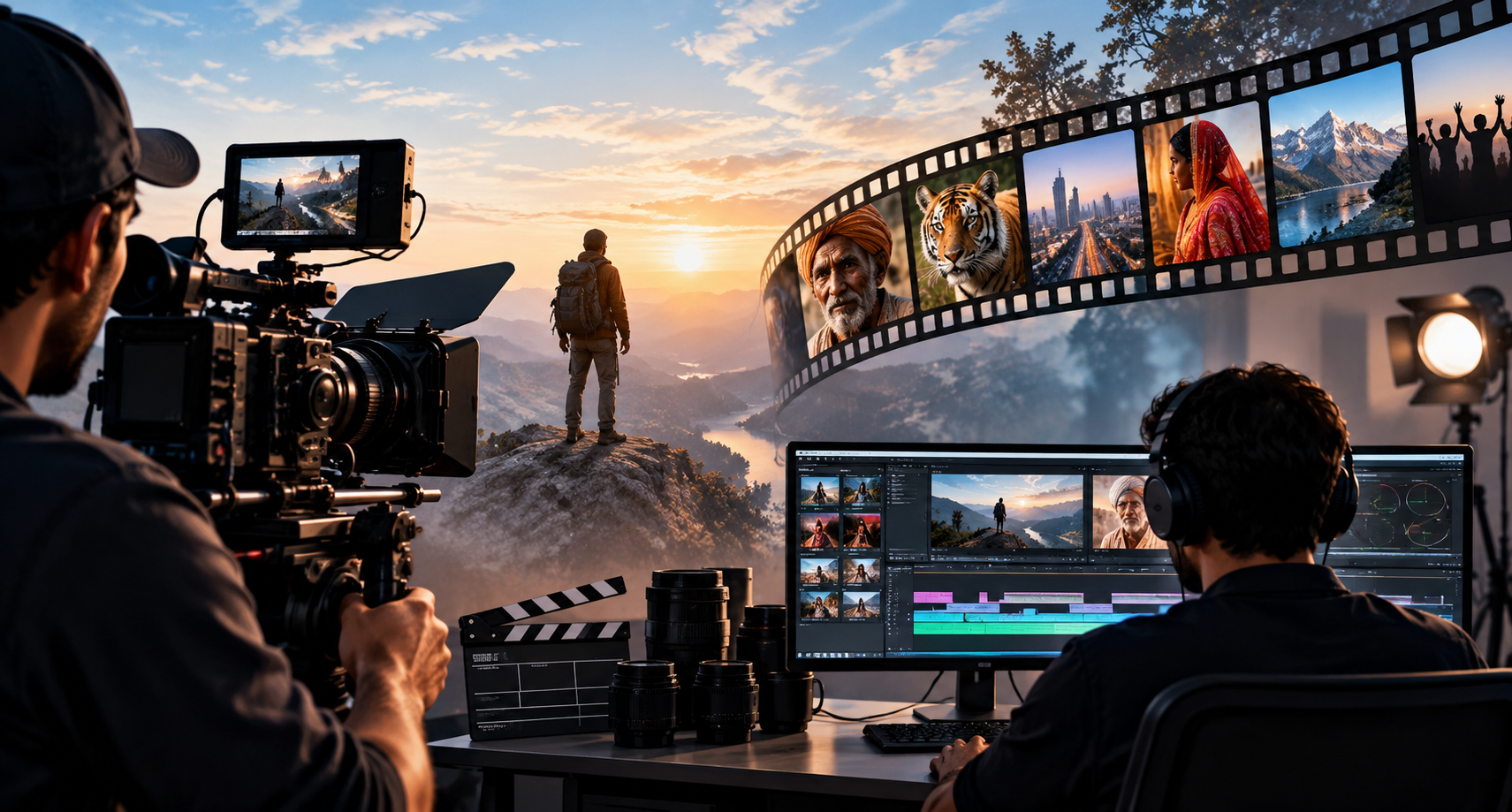
Documentary is the hardest kind of video to make well and the easiest to make badly, because nothing about it can be faked in post. You cannot grade your way to access you did not get, and you cannot edit a story out of material that was never shot. Sunad Broadcast produces documentaries and factual series for broadcasters, OTT platforms, institutions, NGOs and brands, and the thing we spend most of our effort on is the part audiences never see: research, access and structure.
India is an extraordinarily rich environment for factual work and a demanding one to produce in. Distances are long, permissions are layered, languages change every few hundred kilometres and weather windows are narrow. A documentary schedule that would work in Europe routinely fails here. We build schedules that assume the friction rather than hoping it away.
How we approach a documentary
Research and development
We begin with desk research and then move as early as possible to the field. A recce trip with a small crew — often a director and a single camera operator — does three things at once: it tests whether the story actually exists, it establishes trust with the people who will be filmed, and it produces material that can support a funding pitch.
This is also where the honest conversation happens. Some subjects turn out to be a strong twelve-minute piece rather than a series. It is far better to discover that during development than after thirty shooting days.
Access and permissions
Access is the currency of documentary. For Indian productions it usually involves several parallel tracks: informed consent from contributors, permissions from institutions such as hospitals, schools, factories or courts, government clearance where the subject touches a ministry or a protected site, and forest or wildlife permits for natural-history work. Foreign crews additionally require clearance from the Ministry of Information and Broadcasting.
We handle these in-house, keep a documented clearance file for every project, and plan around realistic lead times rather than optimistic ones.
Field production
Our documentary units are deliberately small — often a director, a camera operator, a sound recordist and a local fixer. Small crews get access that large ones do not, move faster, cost less per day and can therefore stay in the field longer, which is usually what determines whether a documentary has a story in it.
We shoot 4K in log with dual-system sound, record long takes rather than cutting in camera, and gather substantial b-roll and atmosphere at every location. Documentary shoot ratios are high by design: twenty or thirty hours of material for a forty-five minute film is normal, and material that feels redundant on the day frequently becomes the spine of the edit.
Editing and structure
The edit is where a documentary is actually written. We begin by transcribing and logging every interview, build a paper edit, then assemble a long first cut that is usually two to three times the final duration. From there we cut for structure — which story, whose point of view, what the audience knows and when.
Narration is a decision rather than a default. Strong observational material usually carries itself and is weakened by a voice explaining it. Narration earns its place when a film needs to move quickly through context that cannot be shown.
Finishing and delivery
Finishing covers grade, sound design and mix, original score or licensed music, graphics and maps, and full subtitling. Documentaries shot across several Indian languages typically need subtitle files in English plus one or two regional languages, and platform-compliant timed text is a technical deliverable in its own right.
Web series and factual series
Series production differs from standalone documentary chiefly in its industrial demands. A six-part series is not six films; it is one production with six episodes, which means a consistent visual language, a repeatable shooting pattern, a graphics package designed once, and an editorial structure where each episode both satisfies on its own and pulls the viewer into the next.
We produce factual series, interview and conversation series, branded documentary series and short-form vertical series for platforms where the entire viewing happens on a phone. For platform commissions we align to the delivery specification before the first shoot day, because retro-fitting an OTT specification onto a finished series is expensive and sometimes impossible.
Who we make documentaries for
Broadcasters and OTT platforms commissioning original factual content or acquiring finished films.
Government departments and public institutions documenting programmes, heritage, research and public infrastructure.
NGOs and development organisations producing impact films, donor communication and field documentation that has to be both truthful and watchable.
Corporates and foundations making brand documentaries, founder films and CSR programme records with genuine editorial substance.
Independent film-makers who need production services, post facilities or a delivery partner in India.
Producing factual work in Indian conditions
Several practical realities shape documentary production here, and a schedule that ignores them will fail.
Distance and transit. A location three hundred kilometres away is not a half-day trip in most of India. We build travel days into schedules explicitly rather than hiding them inside shoot days, which is why our day counts sometimes look higher than a competing quote and our actual delivery dates hold.
Seasonality. The monsoon closes large parts of the country to field production for weeks at a time; Himalayan high passes are accessible for only a few months; agricultural stories are dictated by the crop calendar, not by the client's financial year. Where a subject is seasonal, the season sets the schedule and everything else adapts.
Language and translation. Interviews conducted in a language the director does not speak need a translator in the room who understands what the film is about, not simply someone who can render words. We also budget for full transcription and translation of rushes, because a documentary edited from summaries rather than accurate transcripts will miss the best material.
Power and connectivity. Remote shoots need battery strategy, offline backup and a data-management plan that does not assume an internet connection. We card-offload to two separate drives daily, verified by checksum, before any card is reformatted — a discipline that has saved several productions.
Budgets and funding routes
Documentary is rarely funded from a single source in India, and producers benefit from understanding the realistic options.
Platform commission. An OTT platform or broadcaster funds the production in exchange for a licence, usually exclusive for a defined window. This is the cleanest route and the most competitive.
Institutional and CSR funding. Corporates, foundations, development agencies and government departments fund films on subjects that align with their mandate. Editorial independence needs to be negotiated explicitly at the outset — a film that is visibly commissioned advocacy has a much shorter life than one that is trusted.
Co-production. Two or more producers, often across territories, contribute cash or services against a rights share. This is how a substantial proportion of internationally distributed Indian documentary gets made.
Grants and festival funds. Slower and more competitive, but they carry credibility and frequently unlock the rest of the financing.
We are comfortable working within any of these structures and will tell you frankly when a budget cannot support the film being described. A documentary attempted at half the necessary resource does not become half a documentary; it becomes an unfinished one.
Rights, ethics and the things that sink projects
Two issues account for most documentaries that are finished but never released.
The first is uncleared material. Archive footage, photographs, music, artwork visible in shot and even background television playing in a room all carry rights. We log every third-party element as it enters the edit and clear it for the intended territory, term and media before delivery.
The second is consent that does not cover the actual use. A release signed for a short awareness film does not automatically extend to a global streaming release. We use consent forms that state plainly what the material may be used for, and we re-approach contributors when the plan changes — which is both the ethical position and the one that keeps a film distributable.
We also hold a simple editorial line: we do not stage events and present them as observed, and we do not cut interviews in ways that reverse the speaker's meaning. Beyond principle, it is practical — factual credibility is the only real asset a documentary has.
Start a documentary with us
If you have a subject, tell us what it is, who has access to it and what you want the finished film to do. If you have a treatment and partial funding, we can talk about production services or co-production. If you have footage that has stalled in an edit, send it over — rescuing stalled long-form projects is something we do regularly, and an outside eye on the structure is often all that is missing.
What's included
-
Research and access Subject research, contributor mapping, permissions and location clearance.
-
Field production Small, mobile units for observational and remote-location shooting.
-
Archive and rights clearance Sourcing, licensing and documenting third-party material.
-
Story-led editing Structure, narration, character arcs and episode shaping.
-
Series production management Multi-episode schedules, continuity and consistent delivery.
-
Platform-specific delivery Broadcast, OTT, festival and educational distribution masters.
Let us scope your project
One conversation is usually enough to map deliverables, crew and a realistic delivery date.
Frequently asked questions
How long does a documentary take to make?
A 25 to 45-minute standalone documentary usually takes three to six months: four to eight weeks of research and access, fifteen to thirty shooting days spread across the story's natural timeline, and eight to twelve weeks of editing. Observational work that has to follow real events takes as long as those events take.
What does a web series cost to produce in India?
Factual and documentary web series for Indian platforms typically fall between ₹8 lakh and ₹25 lakh per episode for a 25 to 30-minute episode, depending on travel, contributor access, archive licensing and the level of graphics. Scripted drama series sit considerably higher because of cast, sets and shoot ratios.
Do you handle archive footage licensing?
Yes. We search national and commercial archives, negotiate licences by territory, term and media, and maintain a rights log that records exactly what is cleared for what use. Uncleared archive is the most common reason a finished documentary cannot be distributed, so we treat it as a production department rather than an afterthought.
Can you produce for OTT platform specifications?
Yes. OTT delivery specifications are stricter than broadcast in several respects — 4K masters, HDR where required, IMF or ProRes packages, separated audio stems, timed-text files in multiple languages and rigorous metadata. We build those requirements into the schedule from pre-production.
Will you work on a co-production basis?
For projects with strong subjects and a credible route to distribution, yes. We have contributed production services, post facilities and delivery in exchange for a rights share. Send a treatment and a funding position and we will tell you honestly whether it is something we can back.
Let's scope your documentary & web series production project
One call is usually enough to map the deliverables, the crew and a realistic delivery date.